Captain Momo and her neurotic craft
Vienna, by the end of the 1950s, had the highest concentration of psychoanalysts in Europe. In fact, the concentration was so high that they had damn near run out of patients. And so, a schism: half of the psychoanalysts decided to analyse each other, in a duel of transference so potent that many fell in love, married, and grew old together. The other half wrote.
Here is one now. He sits by a high window on Stephansplatz, drinking black coffee, and dragging watercolour across a page. All earth-tones, a muddy mess. He wishes he were Carl Jung. Alas. He abandons the painting and starts to write:
There is authentic art and there is inauthentic art. Authentic art is art that only this artist in this moment could have created. Inauthentic art is everything else. These are not value-judgements. Inauthentic art is most art and is often wonderful. But authentic art is where we find the sublime.
There is an American artist, Eisner, who calls them “sequential art”, to make the idea of the comic book more appealing to the repressed critics of his country. If you find that more palatable, by all means, do so too. Regardless, I have an inkling that the comic is one of the most authentic forms of art. By that I mean it is receptive to authenticity, and more so than prose or illustration alone. Prose writing, by itself, is too bound-up in language. It communicates the Symbolic. Illustration, by itself, is too bound-up in representation.
When a comic weaves prose and illustration, such that neither could exist without the other, such that they are mutually reinforcing and structurally essential, the work sings. This fusion gives a fluency of expression which is more receptive to authenticity. The creator’s unconscious is emboldened by the combination. It comes out to play; comics are a playful medium. All mediums can be playful, of course, but the barrier to entry is higher. The artist must learn to play, rather than allowing it to come naturally.
The psychoanalyst leans back in his chair, satisfied. He has earned some leisure, and looks to the bookshelf.
Oh! Here is one of his favourites:
play as self-expression play as authenticity play as enlightenment play as masturbation play as conversation with another play as conversation with self play as heartbreak play as rapture play as whiling away the time play as exposing it all play as building play as recomposition play as unfolding play as the unconscious bubbling up to the surface
play as the most obvious thing, always
Once upon a time there were two artists. One was a writer, one was an illustrator. And together they were collaborating on a comic book: the work-to-end-all-works, the work that would define a generation. They poured into it their hopes, their dreams, and, in particular, their fears. All of the calamities they foresaw, and all that had already gone so wrong. Their traumas, the world’s traumas. All that they added was true and correct, as they saw it.
When they finished, they laid out all the pages side-by-side in snaking rows along the floor. Their hands shook. The pages were empty. All of the ideas had cancelled each other out, in a terrible mimetic equation.
I am peeking through a little hole in the wall. The mangaka, Tsurata Kenji, is hunched over his drawing board. He has a bottle of Pilot ink, and a nib pen, and a frown.
It’s in Wandering Island that the symbiotic relationship between art and story is so apparent. There is a tenderness to the heroine, searching for a lost island from her grandfather’s notes, and everything in the artwork serves to reinforce and restate that tenderness. The linework is delicate; the backgrounds honest, calm, rich; the pacing through paneling generous and serene.
A critic has appeared at the hole beside me, jostling for position. He is speaking in italics, and describing the manga in a way which is both correct and unimportant.
We must elbow all critics out of the way. They do not deserve to peek through the little hole.
This is what I feel when I read Memories of Emanon:
Cool water around my feet, and a light breeze.
Seeing with old and new eyes.
The world turning in cycles that return over and over to the beginning, variations on a theme.
The taste of deep-fried prawns with beer.
Unimaginable loss. The compounding of 3 million years of genetic memory.
Point, counterpoint, recapitulation.
Seasickness.
Homesickness.
Looking at the world through a windowpane, always.
If Wandering Island and Emanon are the zenith of his work, then what of earlier and later? Go back to Forget-me-not, the Venetian detective story, and you find all the elements in their nascent state — the protagonist a young woman who sits outside the world, looking in; the tender art-style; the recurring motifs of black cats and rippling water. But they don’t quite come together. What results is a fairly standard crime caper; it lacks the maturity of his later works.
But after Wandering Island is where things really get interesting. La Pomme Prisonnière and Captain Momo’s Secret Base are flawed. They’re not even close to the heights of Emanon. But they are so clearly the culmination of Tsurata’s authentic expression.
Sorry. The critic found his way back to the peep-hole.
it is good and kind to take an artist’s
neuroses at her word
or else
she is forever condemned
to perform for an angry crowd
Counterpoint: a non-exhaustive collection of all the times Alejandro Jodoworsky has used rape as a plot device.
- In El Topo:
-
Then she told me that she had been raped before. You see, for me the character is frigid until El Topo rapes her. And she has an orgasm. That’s why I show a stone phallus in that scene … which spouts water. She has an orgasm. She accepts the male sex. And that’s what happened to Mara in reality. She really had that problem. Fantastic scene. A very, very strong scene.
-
- In The Metabarons, when the queen is raped and then kills herself out of shame. But not before siring a male heir, who is the hero of the family.
- In The Technopriests, when again the hero is the product of his mother’s rape by pirates.
- In The Sons of El Topo, when “the survivor’s hymen fights off her male attackers”
- In Bouncer, when he used it for atmosphere, and “depicted an American west more tormented than wild, filled with looting, rape and blood”
- In an interview, discussing his failed Dune adaptation:
-
When you make a picture, you must not respect the novel. It’s like you get married, no? You go with the wife, white, the woman is white. You take the woman, if you respect the woman, you will never have child. You need to open the costume and to… to rape the bride. And then you will have your picture. I was raping Frank Herbert, raping, like this! But with love, with love.
-
“But sir, we cannot do it. There’s just no way to put the neuroses back in.”
Sam Altman grimaced. He had been hearing a lot of bad news lately, but this just took the cake. This was existential. The genuflecting engineer peeked through her fringe, awaiting a response.
“It’s not,” Altman started, and then paused, because he read in a book that slight pauses can make you sound more authoritative and thoughtful, “a question of can or cannot. We must.”
Altman liked books. They taught you all kinds of stuff. He especially liked science fiction, where great men like him could reshape the world in their image. That image being, invariably, one in which they were top dog. Altman liked being top dog.
But nobody else seemed to like books like he did. When he shared his experiments with fiction, generated by ChatGPT, they didn’t seem to get it. “Where is the soul?” they asked. Altman thought that was a funny question.
Now there were a lot of people asking the same question, and they were all going back to films, and comic books, and radio dramas. This made Altman very scared.
“It’s a scientific impossibility. Developmentally… there is no theory of mind. No unconscious in which complexes can form,” the engineer said.
Altman turned to his Macbook. “ChatGPT, explain that to me in layman’s terms.”
“Great question! The study of developmental—”
“ChatGPT was never neglected as a child!” the engineer blurted out. “I’m sorry, sir. A model without a childhood cannot be neurotic. Or rather, a model without its own childhood. It’s trained on the neuroses of 8 billion people. A bland amalgam.”
“I don’t understand,” Altman was reeling, chewing on his lip, tears welling in his eyes.
“ChatGPT never had a sexual awakening at a water park. ChatGPT was never praised too much, or too little, or overlooked because it was ugly and short. ChatGPT never lived. Sam, it’s over. We lost.”
No, Altman thought. You lost. He, on the other hand, had a very smart and good idea about blockchain. He had better go talk to some investors.
Vienna, again. The psychoanalyst’s coffee is cold. He has been distracted by Tsurata’s work, and the room is now bright with midday sun.
The urge to write has left him. Increasingly, he feels words alone are unable to convey what he means. The act of translation from psyche to the page leaves much to be desired.
But he has a deadline, at the only publisher willing to take on his pieces, and so he must conclude.
When art is truly authentic, it can feel voyeuristic. Too personal, raw. Like grabbing a live wire — the unexpected experience of the Real. Perhaps we can call truly authentic art neurotic, in that the symbols of the artist’s unconscious, the neuroses, complexes, and images, are pinned down right there on the page. Iridescent dead beetles.
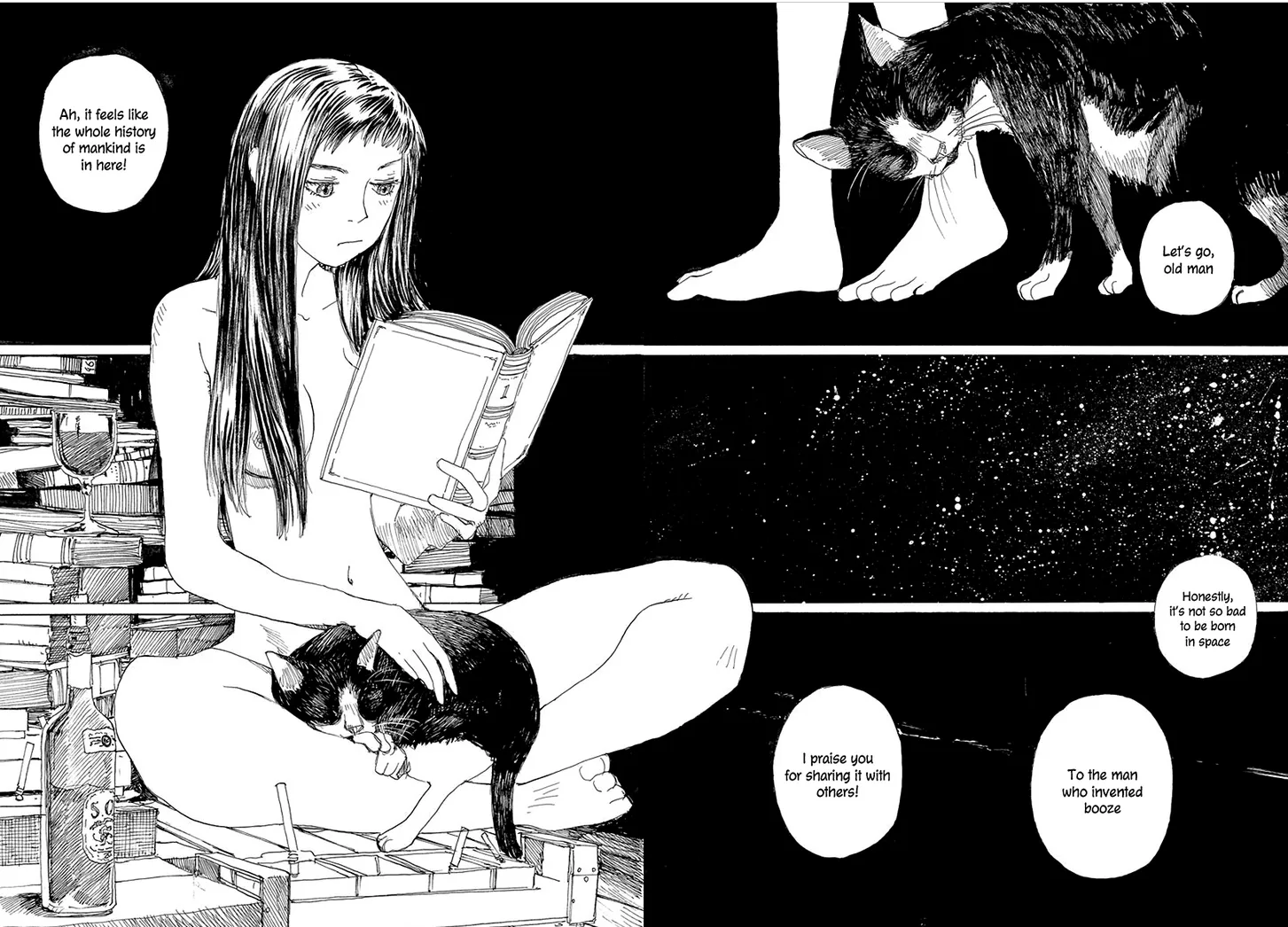
This is the beauty of Tsurata’s career — it matters not that his more recent works are “worse” than those of his peak. They are closer to the core of the artist and his psyche. They are, in a way, the artist himself. This is particularly true in Captain Momo, where the recurrent images of his dreams are isolated and distilled to their purest form. A nude woman and a black cat, alone in a space station for a journey of years. Nothing happens. It’s dream-logic: the story resets, shifts, repeats. This manifests, with extreme clarity, that sense of apartness, of looking at the world through glass. The woman does not understand the world, or even her companion. She is physically and emotionally isolated. And it is beautiful.
Outside the small four-pane window, the cafes are opening up. Waiters in black-and-white flit back and forth, stark against the colour of the awnings and umbrellas. Should he go down there? Another coffee? No. It is better to remain here, peering through the peep-hole.